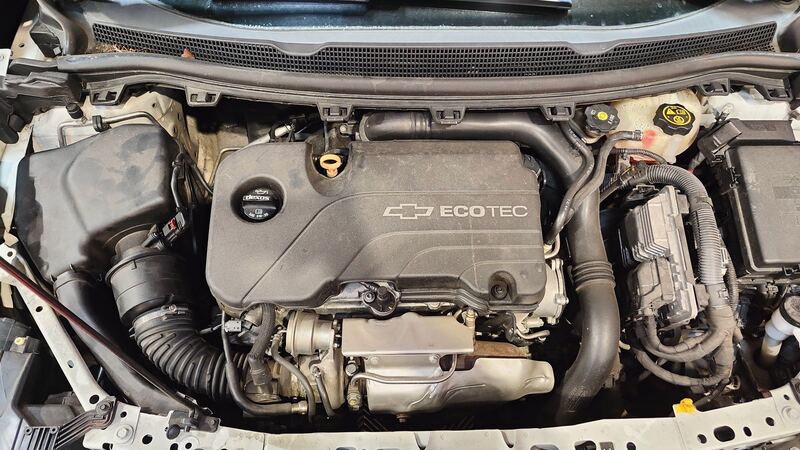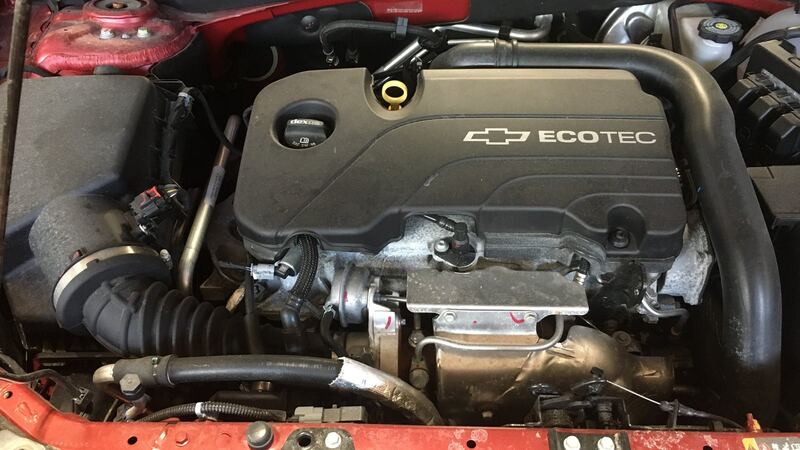
Oil spots on the driveway, a burning smell through the vents, a blue haze at stoplights. Oil leaks are messy and they don't fix themselves. On the second-gen Cruze, though, there's a twist: the leak is often a symptom, and the real problem is pressure building up inside the engine.
Signs to watch for
- Burning oil smell from the vents, especially after highway driving (Samarins lists this as a warning sign on 2016-2019 Cruzes)
- Oil spots under the front of the car
- Oily residue at the back of the engine (rear main seal area) or at the front crank pulley
- Check engine light with P1101 (intake air flow performance)
- Oil level dropping between changes
GM's bulletin: too much crankcase pressure
Bulletin 20-NA-047 covers the 2016-2019 Cruze 1.4L (LE2) plus several other GM small turbo engines (2016-2020 Malibu 1.5L, 2018-2020 Equinox 1.5L, 2016-2019 Encore 1.4L and more). GM's description: an oil leak, a lit check engine light and P1101, caused by higher-than-normal crankcase pressure from a plugged PCV orifice. Samarins adds that the same pressure problem can push oil out of multiple seals and gaskets.
What GM tells dealers to do:
| Step | What the tech does |
|---|---|
| 1 | Measures crankcase pressure at the dipstick tube with the engine hot and idling. Normal is about -1 to -5 inches of water (a slight vacuum). |
| 2 | If pressure is positive, checks the intake duct and air cleaner for restrictions (debris, water, ice, a kinked PCV tube or modifications), and checks for cracked pistons per related bulletins. |
| 3 | Removes the camshaft cover, inspects and replaces the PCV orifice, checks the cover's passages, replaces gaskets as needed. |
The leak above the oil filter
GM's TechLink (August 2022) flagged another common spot on the Cruze 1.4L and related engines: oil that seems to leak from above the oil filter. It may look like the lower crankcase or a porous block, which could lead a shop to quote an engine. GM says warranty analysis points to the turbocharger oil feed pipe fitting at the block, or the engine oil cooler gasket. The fix uses UV dye to find the exact source, then new gaskets or a new fitting.
What it costs
| Repair | Estimated cost |
|---|---|
| PCV valve replacement, Cruze (RepairPal) | $112 to $154 |
| Valve cover gasket, 2016-2019 Cruze (RepairPal, verify locally) | RepairPal shows $60 to $83, but also a general $393 to $482 estimate, so get a written quote |
| Oil cooler gasket or turbo feed fitting | Get a quote after dye testing. Labor varies a lot |
| Rear or front crank seal | Get a quote. Rear main seals are labor heavy |
| Leak diagnosis with dye | Usually billed as diagnosis time |
On the PCV issue, the orifice lives inside the camshaft cover on this engine, so some shops replace the whole cover. Ask which they're doing and why.
Easy things to do first
- Check the oil level every couple of fill-ups. Low oil kills turbo engines.
- Find the drip. Slide a sheet of cardboard under the engine overnight and note where the spots land.
- Clean it, then look again. A degreased engine makes the real source obvious after a short drive.
- Check the air filter and intake. GM's bulletin lists restrictions in the intake path as a cause of high crankcase pressure.
What to ask the shop
- "Did you measure crankcase pressure per bulletin 20-NA-047?"
- "Did you dye test to confirm the leak source?"
- "Could it be the turbo oil feed fitting or oil cooler gasket instead of a seal?"
- "Are you replacing just the PCV orifice or the whole camshaft cover?"
Is it worth fixing?
Usually, yes. The PCV fix is a cheap repair that can stop several leaks at once. A rear main seal is pricier, but on a Cruze that otherwise runs well, it still beats replacing the car. Just make sure the root cause gets fixed so you only pay once.
More Cruze info lives on the Chevrolet Cruze page. Losing coolant too? See our Cruze coolant leak guide. Prices and bulletin details checked October 14, 2026.