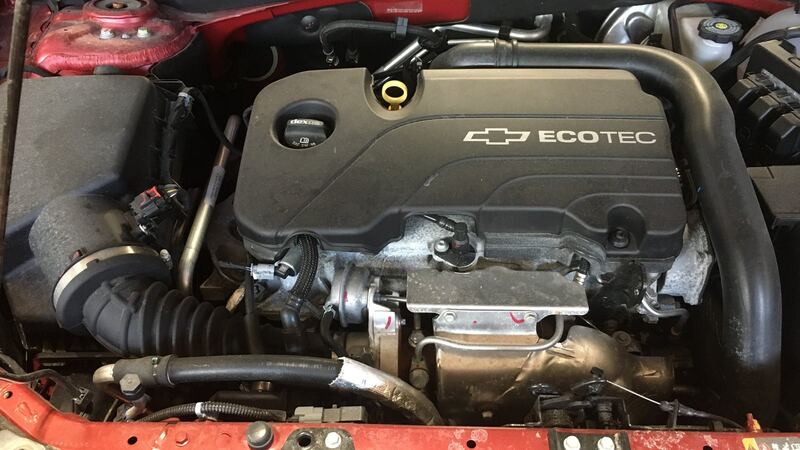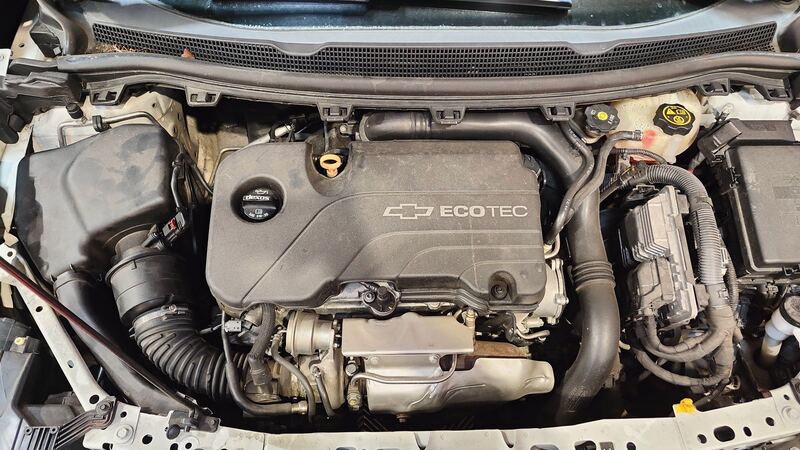
The second-generation Cruze (2016-2019 in the US) uses a 1.4L turbo four-cylinder (GM code LE2) in most cars. It's a decent little engine, but its cooling system has plenty of plastic parts and connections, and owners report the same handful of leak spots again and again.
Signs your Cruze is losing coolant
- A sweet, syrupy smell after driving, sometimes inside the car
- A "low coolant" message, or code P00B7
- The level in the reservoir slowly dropping over weeks
- White or crusty residue around the reservoir cap, hoses or the passenger side of the engine
- Temperature gauge climbing in traffic, or the heater blowing cool air
Where it usually leaks
| Leak spot | What to look for |
|---|---|
| Coolant reservoir (surge tank) and cap | Cracks at the seams or hose necks, wet residue, a cap that won't hold pressure |
| Hose flange and heater hose | Samarins' Cruze review names these as common leak sources on 2016-2019 cars |
| Thermostat housing and water outlet | Plastic housings that seep or crack. Older 1.4T Cruzes were known for this, and owners still report it |
| Water pump | Coolant drips from the weep hole or a whining noise |
Samarins' review of the 2016-2019 Cruze lists the coolant hose flange, the heater hose and the expansion tank as common leak sources, and it lists a bad water pump and thermostat among the car's engine problems.
What it costs
| Repair | Model years | Estimated cost (RepairPal) |
|---|---|---|
| Coolant reservoir replacement | 2017-2019 | $325 to $386 |
| Coolant reservoir replacement | 2016 | $322 to $380 |
| Thermostat replacement | 2019 | $473 to $519 |
| Thermostat replacement | Cruze overall | $442 to $514 |
| Water pump replacement | 2019 | $617 to $823 |
| Water pump replacement | 2018 | $620 to $826 |
| Water pump replacement | Cruze overall | $743 to $1,088 |
| Radiator hose replacement | Cruze | $316 to $355 |
If one shop quotes the water pump and thermostat housing together, that can make sense since they're near each other. Just make sure each part on the quote has a reason.
Easy things to do first
- Check the level cold. Look at the reservoir in the morning before driving. Mark the level with tape and recheck in a week.
- Look and sniff. With the hood up and the engine cool, look for crusty residue and damp spots, especially around the reservoir, the hose ends and the passenger side of the engine.
- Replace the cap. RepairPal suggests replacing the coolant cap along with the reservoir. A weak cap can let coolant boil off.
- Use the right coolant. GM specifies Dex-Cool. Mixing types can cause sludge.
When it's worse than a leak
If you're losing coolant with no visible leak, the oil looks milky, or there's white exhaust smoke, the coolant may be going inside the engine. In one NHTSA complaint, a 2016 Cruze Limited owner (an older-design 1.4T) described repeated overheating at about 72,000 miles with no visible leak. After the water pump, thermostat housing and water outlet were replaced, coolant ended up in the oil and the engine failed. Don't keep topping off and hoping.
What to ask the shop
- "Did you pressure test the system and the cap separately?"
- "Where exactly is it leaking? Can you show me?"
- "Is the thermostat housing or water outlet plastic, and does it need replacing too?"
- "Will you refill with Dex-Cool and bleed the air out properly?"
Is it worth fixing?
Usually yes. A reservoir, hose or thermostat repair runs a few hundred dollars, and RepairPal rates the 2017 Cruze above average for reliability, with average annual repair costs around $545. The math changes only if overheating has already damaged the engine, so fix leaks early.
More Cruze info is on the Chevrolet Cruze page. Smelling oil too? See our Cruze oil leak guide. Prices checked October 14, 2026.