That little horseshoe with an exclamation point loves to show up on the first cold morning of fall. Sometimes it's nothing. Sometimes you're riding on a nail. Here's how to tell, and what each fix should cost at a tire shop.
Solid vs flashing: what your Escape is telling you
| What you see | What it means | What to do |
|---|---|---|
| Solid light | One or more tires are about 25%+ low | Check and fill all four tires |
| Flashes 60-90 seconds, then solid | TPMS fault (dead sensor battery, damaged sensor or electronics) | Get the system scanned at a tire shop |
| Light goes out after you start | Pressures are within range | You're good |
Federal rules have required TPMS on new vehicles since around the 2008 model year, so if your Escape is roughly 2008 or newer, it has one.
Step 1: Check the pressure the right way
- Check cold. Before driving, or after the car has sat for a few hours.
- Use the door jamb sticker. The right pressure for your Escape is on the driver's door jamb, not the max number molded into the tire sidewall.
- Use a real gauge. Gas station gauges are often off. A cheap pencil or digital gauge is fine.
- Then reset. Depending on the vehicle, the light clears with a drive cycle, a dash menu or a button. Your owner's manual has the exact method for your year.
Step 2: If one tire keeps going low
One tire that's always the low one usually has a slow leak. Look for a nail or screw in the tread. A spray bottle of soapy water on the tread and around the valve stem will bubble at the leak.
When a tire can be fixed (and when it can't)
The US Tire Manufacturers Association has clear rules, and good shops follow them:
- The hole must be 1/4 inch (6mm) or smaller.
- It must be in the tread area, not the shoulder or sidewall.
- The tire must be taken off the wheel and inspected inside.
- The fix must be a plug and a patch together (or a one-piece plug-patch). A plug alone is not an acceptable repair.
- No overlapping repairs, and a tire with a bad old repair gets scrapped.
AAA adds that multiple punctures should be at least 16 inches apart to be repairable. Sidewall or shoulder damage means a new tire.
What it costs
| Fix | Typical cost | Notes |
|---|---|---|
| DIY plug kit | $10-$25 | Temporary only, to get you to a shop |
| Shop patch or plug-patch | $25-$75 | The proper permanent repair |
| New tire | $150-$400+ | Depends on size and brand |
| TPMS sensor, average | About $100 | YourMechanic average, labor is most of it |
| TPMS sensor, Escape quotes | About $104-$316 | Varies by year and sensor position |
| TPMS sensor, shop/dealer range | About $116-$550 | Dealers tend to sit high |
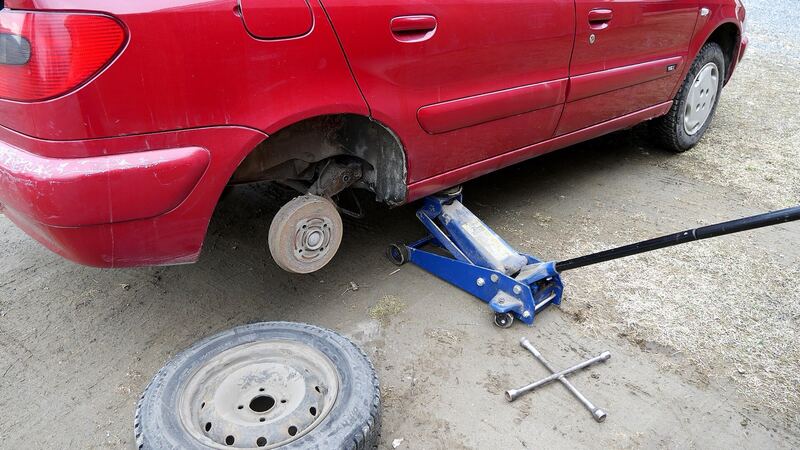
Tire and wheel prices are from AAA, and TPMS sensor prices are from YourMechanic. Since the tire has to come off the wheel to swap a sensor, this is a tire shop job, not a driveway job.
Dead TPMS sensors on older Escapes
TPMS sensors have batteries sealed inside, and you can't replace them. They typically last 5 to 10 years. So on an Escape from the early-to-mid 2010s still wearing its original sensors, a flashing light usually means one (or more) has simply run out. When one dies, others on the same car are often close behind.
After a new sensor goes in, it has to be registered to the car so the system knows which tire is which. Shops do this with a TPMS tool. If a shop rotates your tires or swaps a sensor and the light comes back, ask them to redo the relearn.
What to ask the tire shop
- "Will you take the tire off the wheel and patch it from the inside?"
- "Is the hole in the repairable tread area?"
- "Does the sensor price include programming and the relearn?"
- "How old are my other sensors? Should I replace them now while the tires are off?"
Is it worth fixing?
Almost always. A $25-$75 patch beats a new tire, and fixing a TPMS fault means you'll actually get warned next time you pick up a nail. The one exception: if a sidewall is damaged or the tire is already worn near the wear bars, skip the repair and buy the tire.
More Escape repair info is on the Ford Escape page. Engine using coolant? Read our Escape 1.5L EcoBoost guide. Prices checked October 14, 2026.